The Auren Chronicles: books written inside the world. Each speaks for its own people, and they do not agree. Read them for what their writers believed. For what is settled, read the Codex.
Copied by northern scribes from elder household rolls, travellers' testimony and hearth tales
Edition
First edition
Length
24 chapters, about 8200 words
Wulfstead's witness to Ēadweard, Morgen and Arabel and the household gathered round them; the broken handfasting, the Falling Star and the Dicing-Hall; and how the survivors' blood and customs came to Wulfstead.
Set down from the river tablets, temple accounts and household lists of Sarru-kin
Edition
First edition, corrected 9 November 2026 (the series is eleven volumes, not five)
Length
20 chapters, about 5600 words
Sarru-kin's own account, from Oruun and the First Note to the Azhurathi and their Covenant, Odravan's crown, the days of closed sanctuaries, the Vareshin, and the city's quarrel with the law of the winners.
The Crown's own account, from the court at Aurelium, with northern and foreign hands left standing in its margins
Edition
First edition
Length
20 chapters, about 10000 words
How the Crown tells its founding after the Sundering; the Hunters; Eadric and the six who sit with him; the seven virtues; Ianoria's three faces; the Collegium; Frithholm; and the nineteenth winter.
Collected in Wulfstead from hearth tellers, ferrymen and midwives, by men who could write
Edition
First edition
Length
8 chapters, about 2000 words
The least certain and most borrowed book in Wulfstead. The hob that would not be paid, the Barghest, the seal-wife, the rider at the ford, the Wild Hunt, and Melfed the crab.
An unnamed compiler who sailed between the five cities, "accused of favouring every party in turn"
Edition
First edition
Length
8 chapters, about 1800 words
Lykonia, Oreia, Kallipolis, Thalassa and Naxara, each with its own account of the first stone in its harbour; and the three arguments over Crown, League and the power beneath the land.
An unnamed scribe writing "what the households remember, not what the northern rulers order a stranger to repeat"
Edition
First edition
Length
7 chapters, about 1600 words
The Falling Star as Draugheim remembers it, Ívarr's embers, the Thing at the thawless fjord, the draugr and the buried debt, and three futures for the north.
A traveller's atlas of "the currently circulated map"
Edition
First edition
Length
8 chapters, about 1700 words
The settlements of Brigantis and the Southern Isles as named on the present map, and an honest warning that an atlas can be right about a bridge and wrong about a border.
What a House is, blood and fostering, the ladder of honour, guest-right, the Thing and the price of peace, the bonds of labour, and the two kinds of law.
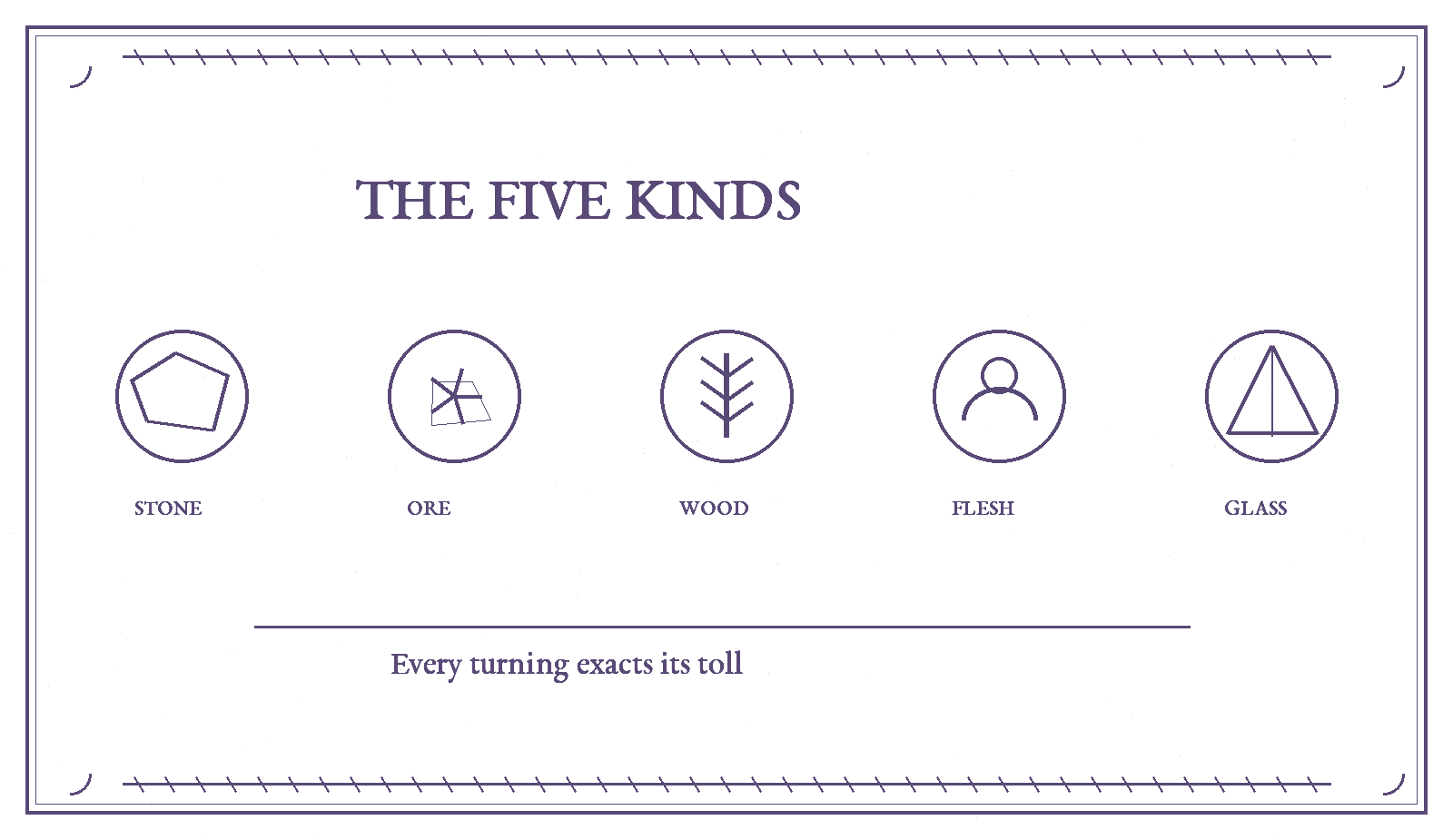
Saen and the veins of the earth, Wemm, blood that sleeps, Wending and the Five Kinds, galdor and blōt, the unblooded, and the broken bridge three schools mended together.
Hobs and boggarts, wisps and green-wardens, black dogs and the Wild Hunt, water-horses and selkies, the dead and the made, the gatekeepers of Sarru-kin, relics, and a record of false monsters.
The compilers of a public register, who "contain no key to forbidden sanctuaries"
Edition
First edition
Length
11 chapters, about 2600 words
The islands and their peoples, the quarrel of divinity, the arts, the House and the burh, the towns to know, the living year, and how to read the sources against one another.
Where the books disagree
The same thing, told two ways. In the game these pages open in the Library’s catalogue once a reader has carried both books.
The Crown's chronicler writes that Draugheim refused the Seven, and that "the punishment of that refusal is written in the cold". He admits he does not know every cause of a storm.
The Frostbound Witness gives a ferryman who says the first snow fell the day the northern star struck the land, and a priest who says the frost was renewed when the people would not forget the Ember-Son.
Neither book can prove its cause. The cold is the one thing they agree on.
The Wulfstead Testament calls the Hunters the Order of the Just, and the common folk called it the Wrong. "They bore borrowed powers and served the will of the throne."
The Aurelium Testimony says they "won battles that armies had been unable to fight", and offered the hard notion that no one might be beyond judgement.
Whether the Hunters became the Crown, the Testament says, "is not proven". Three courts demanded an answer, and each was given a different one.
The Crown tells its beginning as a rescue: after the Sundering, Eadric gathered ferrymen, judges and tired soldiers and made a broken world agree on a few things.
The oldest Wulfstead testimony does not deny the slaughter of the elder days. It records the Falling Star and the dead within the Sealing. "A rescue may be real and still become a conquest."
The Book of Marble and Salt gives Kharisia five cities: Lykonia, Oreia, Kallipolis, Thalassa and Naxara, the five on the living map.
The Aurelium Testimony notes that older scholars still speak of Marmaros, Pelagia and Logeion, "and the reason for their disagreement is worth a book of its own".
The Wulfstead Testament traces families to the First Household and the gifts that sleep in their blood.
The Treatise of Blood and Wending answers that "the craft called Wending is learned rather than inherited, though some bloodlines seem to approach it more easily".
Families keep their teaching, and so each House is known for its Bent. Blood is another thing.
Sarru-kin's tablets count back to Oruun and the First Note, and call the river city the first. The Wulfstead Testament begins with the First Household in the north.
Neither book places the other's beginning in its own reckoning. The order of the ancient past is uncertain, and the Codex keeps it so.
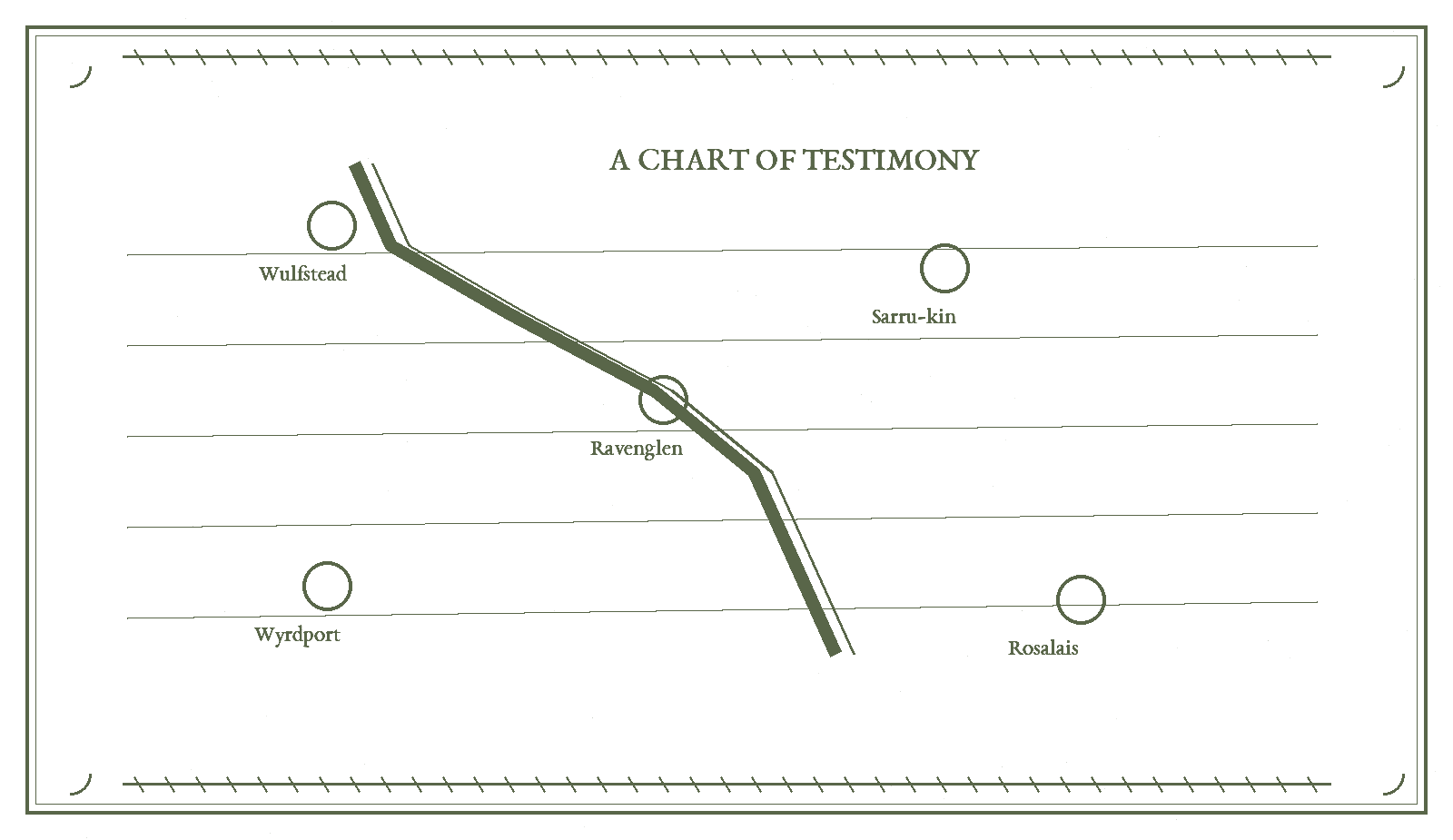
The plates are original line drawings made for this edition, interpretations rather than surviving artefacts; the place diagrams are not surveyed maps. The editable manuscripts are kept by the owner; this copy is made from them and checked word for word. About the sources